
Enterprise SIGs die in the inbox. Small businesses still need to know what a vendor touches, who can get in, and who owns the follow-up — before the next SaaS signup, not after the breach questionnaire lands.
Scarlet Risk is the foundational risk layer for SMB operators. This piece is a practical one-pager you can send and reuse. Not a theater binder. Not a cheaper-than-Vanta pitch. Protection is the point; certification is a byproduct when it matters.
Why SIGs fail SMBs
Got a security questionnaire? See your gaps first. Get your free Risk Snapshot.
Get your free Risk SnapshotA 200-question SIG assumes a third-party risk team, a shared drive of evidence, and time nobody has. Founders and MSPs get a form, stall, and call it “vendor management.” Diligence without answers is cosplay.
What works instead: a short page with labels operators understand — Confirmed / Partial / Planned / Gap / Client-owned — and a clear escalate-to-SOC-2 rule when the vendor holds crown jewels (customer PII, production access, payment data, regulated workloads).
The 12-question spine
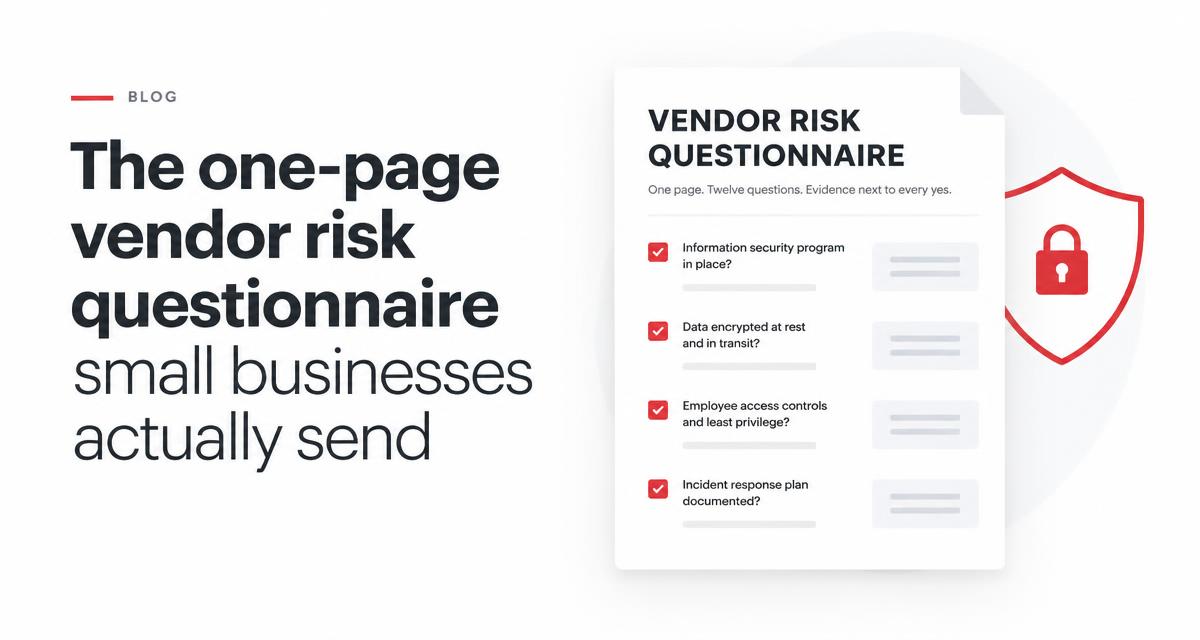
Use these as the spine. Adapt language; keep the intent.
- What product/service do you provide us, and what business process depends on it?
- What categories of our data can you access or store (none / metadata / customer / regulated)?
- Where is that data processed and stored (regions / subprocessors you rely on)?
- How do you authenticate admin access (SSO / MFA / password-only)?
- How do you provision and revoke our users’ access — and within what SLA?
- Do you encrypt data in transit and at rest? Where is that stated?
- How do you notify us of a security incident that may affect our data (channel + timeline)?
- When was your last independent security assessment (SOC 2 / ISO / pen test summary) — and can you share the cover letter or bridge letter?
- Who is our named security / privacy contact on your side?
- Which of your critical subprocessors touch our data?
- What is your backup / recovery objective that matters to our uptime?
- What happens to our data at contract end (return / delete / certify)?
Score each: Confirmed (evidence attached), Partial, Planned (date), Gap, or Client-owned (we hold the control).
Escalate-to-SOC-2 rule
If the vendor stores or can access customer or regulated data and you cannot get Confirmed answers on access, MFA, incident notice, and data disposition, escalate: require a current SOC 2 (or equivalent) package, or do not expand scope. Automation platforms (Secureframe, Scrut, Sprinto) help vendors produce evidence; your job is still the living diligence page — foundation first.
MSP reuse
MSPs: keep one master questionnaire. Per client, swap answers and evidence links — do not rewrite from zero. Same labels across the book. Put screenshots next to every “yes” insurers or buyers will ask about.
20-minute honesty pass
- Name the five vendors that would hurt most if they failed tomorrow.
- Send the one-pager (or fill what you already know).
- Attach evidence or mark Gap.
- Date the page. Assign one human owner.
Free Risk Snapshot (through Oct 31)
If you want a one-page view of where vendor and related risk may be building up — plus three practical next moves — claim a Free Risk Snapshot at https://scarletrisk.com/risk-snapshot. Through October 31 only. About three minutes. No sales call required. Optional short follow-up is a clarity pass, not a free consulting hour.
Want a second set of eyes on your vendor list once it’s filled in? Grab a short call with Pete: https://calendly.com/pete-scarletrisk/30min. No deck, no pressure.
Got a security questionnaire? See your gaps first. Get your free Risk Snapshot.
Get your free Risk Snapshot