
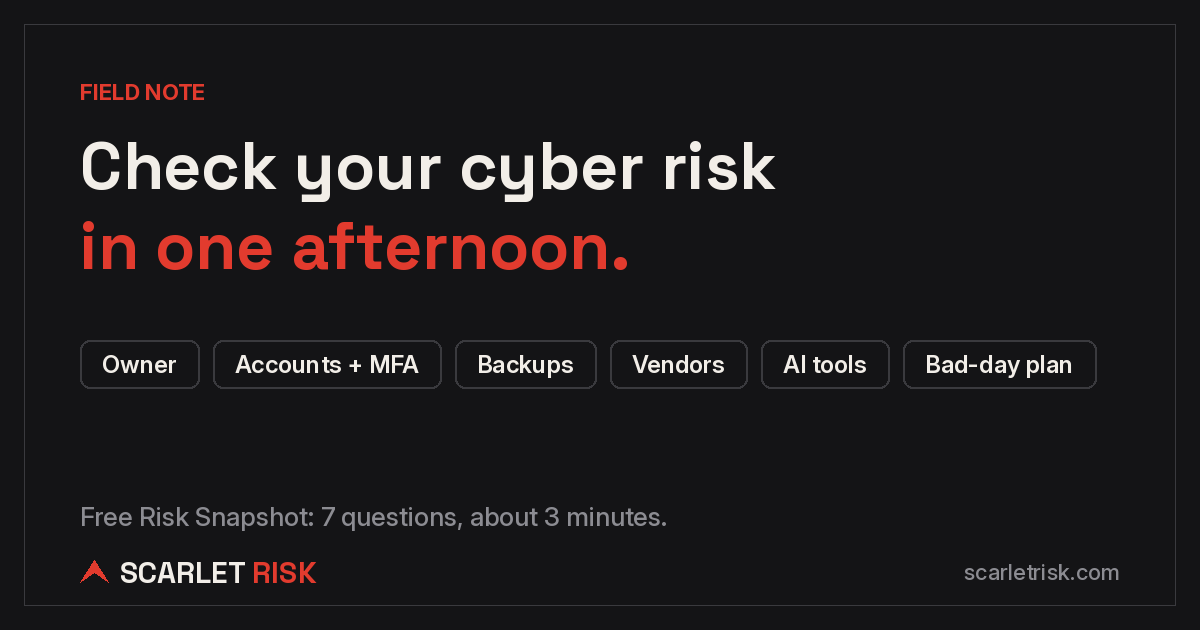
Yes. A small business can check its cyber risk in an afternoon, and there are free ways to start. The quickest is a short self-assessment, like the free Scarlet Risk Snapshot: 7 multiple-choice questions, about 3 minutes, no signup to start, and you see your score band and top 2 risk areas on screen. CISA and NIST also publish free guidance written for small businesses. What a free check won't do is fix anything for you. The value is a short, honest list of what to fix first.
This post walks through what a useful check covers, which free options exist, and what to do with the results.
What "checking your cyber risk" actually means
See your biggest risk gaps in 3 minutes. Get your free Risk Snapshot.
Get your free Risk SnapshotFor a company without a security team, a risk check isn't a penetration test or an audit. It answers five plain questions:
- Who owns this? If nobody is clearly responsible for security, every other answer gets weaker.
- Can someone get into your accounts? Email and the handful of systems that hold money or customer data are where most trouble starts. Is multi-factor authentication turned on for all of them?
- Could you recover? If a laptop died or files got encrypted tomorrow, do you have backups you've actually restored from?
- Who else has access? Vendors, contractors, your IT provider and the apps people connected to your email or file storage.
- What would you do on a bad day? A one-page plan with names and phone numbers beats a binder nobody has opened.
If you can answer those honestly, you know more about your risk than a lot of companies twice your size.
Free ways to check, and what each one is good for
A quick self-assessment. The Risk Snapshot is built for owners and ops leads without a compliance hire. You answer 7 questions about ownership, accounts, backups, vendors and AI tools. You see your score band and your top 2 risk areas right away. If you add your name, work email and company, you get the full one-page Snapshot by email, with your biggest cyber, vendor, AI and compliance gaps and what to fix first. It's free, with no credit card and no sales call required. It's a plain-language summary, not an audit or a penetration test.
Government guidance. CISA's Cyber Essentials is a starter kit for small business leaders, organized around where to begin. NIST's Small Business Cybersecurity Corner collects guides for small teams, including one for the self-employed and a finder for regional programs that help small businesses. CISA also offers no-cost Cyber Hygiene services, including scanning of internet-facing systems, aimed at critical infrastructure organizations. Check whether you qualify.
Your own IT provider or MSP. If someone already manages your systems, ask them the five questions above. A good MSP can usually answer the account and backup questions from their own tools in a day or two.
None of these replaces the others. A self-assessment tells you where you're exposed. The government guides tell you what good looks like. Your IT provider can confirm what's actually configured.
A one-afternoon check you can run yourself
Block two hours. Bring whoever handles IT, even if that's you.
1. Name an owner (10 minutes). One person, by name, is responsible for keeping this list current. It doesn't have to be a full-time job. It has to be someone.
2. List your critical accounts (30 minutes). Email, banking and payments, payroll, your main file storage, your CRM or customer database, and your domain registrar. For each one, write down whether multi-factor authentication is on for every user. Anything with a "no" goes to the top of the fix list.
3. Test one backup (30 minutes). Pick one important folder or system and restore a file from backup. If you can't, or you don't know where the backups are, that's your second fix.
4. List who else has access (30 minutes). Vendors, contractors and your MSP. Then look at the third-party apps connected to your email and file storage, and remove the ones nobody recognizes. If you've never done a vendor review, the one-page vendor risk questionnaire is a simple place to start.
5. Add your AI tools (15 minutes). Ask your team which AI tools they use for work, including personal accounts, and what data goes into them. You don't need a policy today, just the list. Our shadow AI inventory guide shows a four-column version.
6. Write the bad-day page (15 minutes). Who do you call first? Your IT provider, your bank, your insurer, and whoever can speak for the company. Put names and numbers on one page and share it.
At the end you'll have a short list, ranked by what's easiest to break into and hardest to recover from. That list is your risk check.
What to do with the results
Don't try to fix everything at once. Pick the top three and give each one an owner and a date. For most small businesses, the top three end up being some mix of turning on multi-factor authentication everywhere, confirming backups restore, and cleaning up old access.
Then put a review date on the calendar, every quarter or whenever you add a major vendor or tool. Risk changes when your business changes: a new hire, a new payment system, a new customer that sends you a security questionnaire.
That last one is worth planning for. Larger customers, insurers and partners increasingly ask small vendors how they handle security. A current, honest risk list makes those questions a lot easier to answer, whether you sell to a regional credit union, a hospital group or a software company.
How World Watch can help
Your internal check covers what you control. It doesn't tell you what's changing outside. Scarlet World Watch is a global threat and risk map refreshed hourly from public news and travel advisories, so you can see reported ransomware activity, vulnerabilities and supply-chain incidents as context for your own review. It's included in the Scarlet Elite and Team plans, and the map on the site is an illustrative sample feed. Public news signals aren't a prediction that something will happen in your systems.
Where Scarlet fits
I'm building Scarlet Intelligence for small teams without a compliance hire. The free Risk Snapshot is the starting point and stays free. If you want to keep the list going, with a risk register, policies and vendor reviews in one place, there's a free 14-day Scarlet Pro trial, no card needed.
Start here: Get your free Risk Snapshot. If you'd rather talk through what you find, grab 30 minutes with me.
Pete Macias, Founder, Scarlet Risk
Sources
- Scarlet Risk, Risk Snapshot page and FAQ: scarletrisk.com/risk-snapshot
- CISA, Cyber Essentials: cisa.gov/cyber-essentials
- CISA, Cyber Hygiene Services: cisa.gov/cyber-hygiene-services
- NIST, Small Business Cybersecurity Corner: nist.gov/itl/smallbusinesscyber
- Scarlet Risk, World Watch: scarletrisk.com/intel/world-watch
See your biggest risk gaps in 3 minutes. Get your free Risk Snapshot.
Get your free Risk Snapshot